Self-Guided Seoul Tours: The 2026 Complete Guide
A no-fluff guide to Seoul on your own in 2026 — four themed walking tours, a 3-day sample itinerary, transit and payment tips, and how to use K-Quests to turn the city into a playable map.
Self-Guided Seoul Tours: The 2026 Complete Guide
Seoul is one of the easiest megacities in the world to explore on your own. The subway is signposted in four languages, payment works with tap cards, most young people speak enough English to help with directions, and the neighborhoods you actually want to see are walkable once you're inside them. If you're the kind of traveler who hates being herded onto a tour bus, you're in the right city — and this guide is for you.
This is a no-fluff guide to self-guided Seoul tours in 2026. Four themed walking routes, a sample three-day itinerary, real logistics (the stuff nobody tells you until it's 11pm and your foreign card declines at a taxi), and how to turn the city into a playable map with the K-Quests app.
Why self-guided beats a package tour in Seoul
Package tours in Seoul charge $80 to $150 a day to show you the outsides of three palaces, a jade store, and a forgettable lunch. You spend half the day on a bus. You see nothing you couldn't find in an hour of planning.
A self-guided Seoul tour costs what you choose to spend on food and transit, gives you time to actually sit in a hanok café or finish a meal, and lets you follow your own curiosity. The only thing a package gets you is a narrator — and in 2026 your phone does that better.
You can do Seoul self-guided if you can do these three things:
Tap a card on a subway turnstile
Read a Google-style map (we'll use KakaoMap)
Walk 12,000 to 18,000 steps in a day
That's it.
What you need before your first self-guided tour
A T-money card. Buy it at any convenience store (CU, GS25, 7-Eleven, Emart24) or at any subway station kiosk. It costs about ₩2,500 empty and you load it with cash. T-money works on every subway line, every bus, and most taxis. Don't leave the airport without one.
KakaoMap or Naver Map. Google Maps walking directions are broken in South Korea for regulatory reasons. KakaoMap is the local standard — set it up before your first full day. Naver Map is the common alternative. Both are free and both are in English.
A data plan. Either a Korean eSIM (Chingu Mobile, KT M Mobile, SK Telecom 5G prepaid) or a pocket WiFi rental at Incheon or Gimhae airport. A T-money card without data is a very frustrating combination.
Papago. The Naver-built translation app. Handles menus, handwritten signs, and spoken conversation better than anything else for Korean.
A comfortable pair of shoes. Seoul is hilly and cobbled in the old neighborhoods. You will regret fashion shoes within three hours.
The four self-guided Seoul tours worth doing
Each of the following routes is a real, walkable themed day. We've built a K-Quests challenge around each one so you can follow a gamified version of the route — earn badges, collect photos at GPS-pinned spots, and unlock hidden challenges. If you prefer to freestyle the route without the game, everything below works as a standalone guide.
1. Palaces & Temples self-guided walking tour
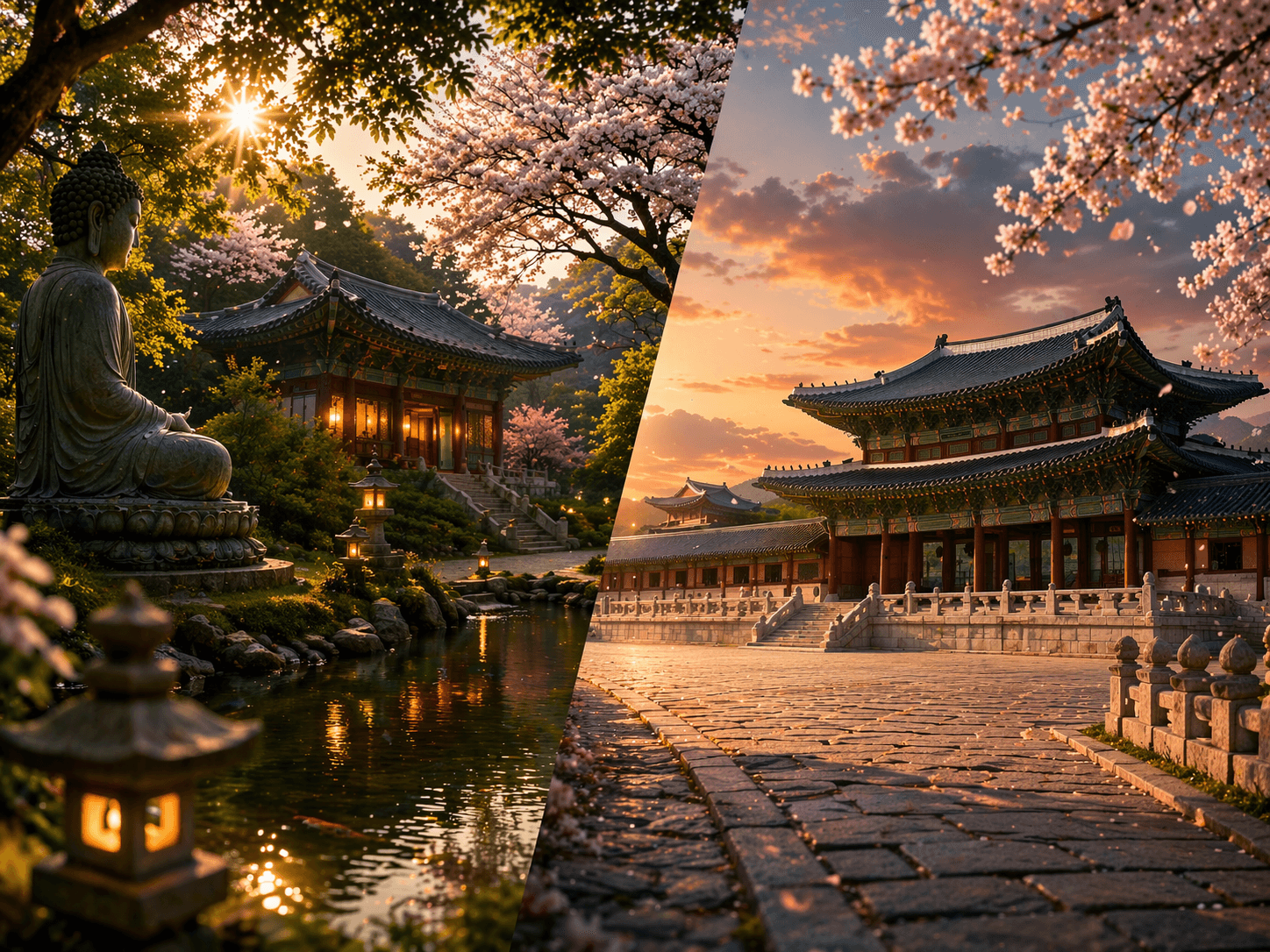
Seoul has five Joseon-era palaces within 2km of each other plus Jogyesa, the flagship temple of Korean Buddhism. You can hit the three best ones in a single day.
Route (start early, around 9am):
Gyeongbokgung — the biggest. Try to arrive for the changing of the guard at 10am or 2pm. Free entry if you're wearing a rented hanbok (about ₩15,000 for four hours at any nearby shop).
Walk east through Samcheong-dong — cafés, galleries, hanok houses. This is the postcard Seoul.
Bukchon Hanok Village — the residential area between Gyeongbokgung and Changdeokgung. Go slow. Real people live here; no bullhorn tours.
Changdeokgung plus the Secret Garden (Huwon) — UNESCO World Heritage, and the Secret Garden requires a separately-timed ticket (book ahead online).
Walk south to Jogyesa Temple in Insadong. Free entry, active temple, incense smoke and monks.
Dinner in Insadong or Ikseon-dong.
Total walking: 6-8km. This is the easiest self-guided tour to do on your first full day because everything is connected and signposted.
→ Play it as a quest: Temple & Palace Quest — six GPS challenges, unlocks a badge, and includes lesser-known temple spots most guides miss.
2. K-Pop Seoul self-guided tour
If you're coming to Seoul for the music, skip the generic "K-pop tour" operators. You can hit every iconic entertainment agency on your own for the price of a subway ride. The payoff is the same photo; the saving is about ₩120,000.
The big four headquarters:
HYBE HQ (Yongsan) — home to BTS, SEVENTEEN, LE SSERAFIM, NewJeans. Exterior only, but the building is the photo op. Nearest station: Yongsan (Line 1).
SM Entertainment (Seongsu) — aespa, NCT, RIIZE. Newer HQ in Seoul Forest area.
JYP Entertainment (Cheongdam-dong / Gangdong) — TWICE, Stray Kids, ITZY. Worth combining with a Seongsu visit.
YG Entertainment (Hapjeong) — BLACKPINK, BABYMONSTER. Near the Hongdae nightlife district.
Add-on stops:
LINE FRIENDS flagship (IFC Mall, Yeouido) — BT21 merchandise
Official fan signing venues (check Weverse/Bubble for current week)
KPop Academy cafés in Hongdae and Seongsu — dance studios open to visitors
Cap the day with a concert at the Jamsil Arena or Gocheok Sky Dome if the calendar works.
→ Play it as a quest: K-Pop Seoul Quest — GPS challenges at every major agency, idol training landmarks, and hidden fan-meet spots.
3. K-Drama filming locations self-guided tour
K-drama tourism is a real thing. Filming locations are free to visit and most of them are places locals already go — parks, bridges, convenience stores, university campuses. You don't need a tour; you need a good list.
Seoul's most-filmed spots:
N Seoul Tower (Namsan) — seen in nearly every romance drama. Take the cable car up, walk down through Namsan Park.
Bukchon Hanok Village — Goblin, Mr. Sunshine, countless others.
Ewha Womans University campus — featured in too many dramas to list. Public, free, gorgeous architecture.
Han River parks (Yeouido, Banpo) — night scenes, chicken-and-beer picnics, the Rainbow Fountain at Banpo Bridge.
Cheonggyecheon stream — downtown walking scenes.
Gwanghwamun Square — protests, grand-gesture reunions.
Pair this with a stop at a featured café or convenience store if the drama called one out — half the fun is recreating the scene.
→ Play it as a quest: K-Pop Demon Hunters Quest — a demon-hunting K-pop squad protects Seoul; eight GPS challenges across the city.
4. Cherry blossom self-guided tour (spring only)
Cherry blossom (벚꽃, beotkkot) peak in central Seoul is typically late March to mid-April. Late April is tail-end in Seoul but still peak in higher-elevation spots like Gangneung and Chuncheon, and full bloom in Jeju by early April. Check the Korea Meteorological Administration bloom forecast before you plan.
Best Seoul cherry blossom spots (self-guided):
Yunjungno (Yeouido) — the famous 1,400-tree avenue along the National Assembly. Festival in early April.
Seokchon Lake (Jamsil, next to Lotte World Tower) — lake circuit with blossoms reflecting on the water. Best after sunset.
Namsan Park — pair with N Seoul Tower.
Changgyeonggung at night — limited-window evening openings during peak bloom.
Seoul Forest — less crowded, great for picnics.
Bring a mat, buy convenience-store soju and snacks, claim a tree, and you've done it right.
→ Play it as a quest: Cherry Blossom Quest — four GPS challenges at Seoul's best bloom spots, updated yearly for peak timing.
Sample 3-day self-guided Seoul itinerary
Day 1 — Palaces & Old Seoul: Gyeongbokgung → Bukchon → Changdeokgung → Insadong → dinner in Ikseon-dong.
Day 2 — K-Culture: morning at a K-pop agency HQ of your choice → Seongsu cafés → afternoon at an Ewha / Bukchon drama location → Han River evening picnic.
Day 3 — Neighborhoods & nightlife: Gwangjang Market breakfast → Dongdaemun Design Plaza → Seongsu for shopping → dinner in Hongdae → late-night Ikseon-dong or Itaewon.
Add a fourth day for a DMZ day trip or a KTX run to Busan (2h 15m, ₩60,000 one way).
Budget: what a self-guided Seoul day actually costs
Backpacker day (~₩70,000 / $50): - Hostel bed: ₩25,000 - Subway + bus: ₩5,000 - Breakfast (convenience store): ₩5,000 - Lunch (kimbap, tteokbokki): ₩8,000 - Dinner (Korean BBQ set): ₩25,000 - Café stop: ₩6,000
Mid-range day (~₩220,000 / $160): - Hotel: ₩120,000 - Transit: ₩6,000 - Meals: ₩50,000 - Attractions / hanbok rental: ₩20,000 - Drinks + café: ₩25,000
Seoul is still cheaper than Tokyo, meaningfully cheaper than Singapore, and dramatically cheaper than London or NYC for food quality.
How K-Quests makes self-guided Seoul easier
K-Quests is the app that turns Seoul into a playable map. Every route in this guide exists as a quest with GPS-pinned challenges, a themed badge, and a map styled to match the quest (neon purple for K-pop, pastel pink for cherry blossoms, crimson for palaces).
You don't need it to do a self-guided tour. You do need it if you want:
A curated, tested route instead of Reddit threads from 2019
A way to earn something (badges, leaderboard rank) as you walk
Interactive map view of every challenge across every quest
A leaderboard to compete with other travelers
Proof-of-visit for each spot you actually hit
New to the app? Start with the how-to-play guide.
FAQ — self-guided Seoul tours
Is Seoul safe for solo travelers? Yes. Seoul has one of the lowest violent-crime rates of any major city. The common-sense rules apply (watch your drink, know where you're staying), but solo female travelers, solo older travelers, and first-time solo travelers consistently rate Seoul among the easiest Asian cities for DIY trips.
Do I need Korean? No. Subway signs, restaurant menus in tourist areas, and most big-chain cafés handle English. Outside tourist zones, Papago + pointing + good humor covers the rest. Learn "annyeonghaseyo" (hello), "gamsahamnida" (thank you), and "igeo juseyo" (this one please) and you'll be fine.
How do I pay for things? T-money card for transit. A foreign Visa/Mastercard for most stores and restaurants. Cash (₩10,000 notes) for small vendors and street food. Apple Pay works at Hyundai Card terminals. Korean payment apps (KakaoPay, Naver Pay, Toss) are not available to short-term tourists.
Can I use my US/EU bank card? Mostly yes at chains and restaurants. Some smaller places are cash-only or Korea-card-only. Always carry ₩30,000 in cash as a buffer.
What's the best season for self-guided Seoul? Late March to mid-April (cherry blossom) and mid-October to early November (autumn foliage) are the premium windows. Summer is humid and storm-prone; winter is cold but dry and excellent for palace photos.
Is Seoul walkable? The neighborhoods are. The distances between neighborhoods are not — that's what the subway is for. Plan 2-3km of walking within each district and subway between them.
Ready to start?
Pick one of the four quests above, download the K-Quests app, and walk out your hotel door. Seoul rewards the curious. A package tour would have you back on the bus by the time you've finished your first coffee.
Start here: - Browse all quests on the map - Temple & Palace Quest - K-Pop Seoul Quest - Cherry Blossom Quest - K-Pop Demon Hunters Quest